

















- The Key Takeaways
- How the Simone Biles–Charlie Kirk Fake Blog Post Went Viral
- Debunking the Hoax: Fact Checking the Simone Biles Post and Charlie Kirk Claims
- Conspiracy Theories, QAnon, and the Deep State: Why People Believe This Stuff
- The Real Dangers of AI-Generated Fake News about Simone Biles Post
- Frequently Asked Questions
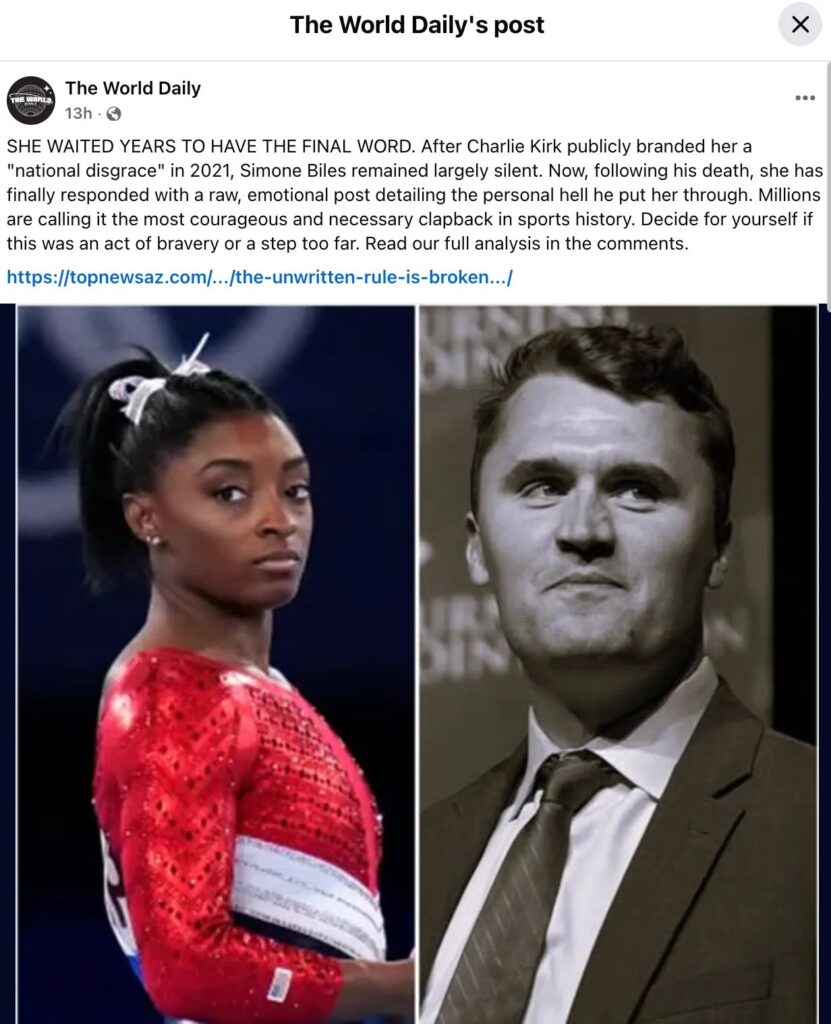
Did Simone Biles clap back at Charlie Kirk from beyond the grave with some brutal blog post? Nope. She never wrote a single word about Charlie Kirk after his death, and the so-called “blog” blowing up on Facebook is 100% fake, cooked up by AI clickbait factories.
But that didn’t stop the internet from eating it up like it was gospel truth.
I’ve been around long enough to know how this game works—mix a little bit of real history (Kirk trashing Biles back in 2021) with some spicy AI-generated nonsense, and boom, you’ve got a viral hoax. It’s the perfect recipe for chaos on social media, and people are too busy rage-sharing to stop and fact-check.
That’s why I’m breaking this down. You’ll see how the fake post spread, why people fell for it, and why AI-fueled lies like this are only going to get messier.
Buckle up, because this one’s a wild ride through the foolish corner of the internet.
The Key Takeaways
- Simone Biles never wrote a blog about Charlie Kirk
- Viral posts used AI to mix old insults with fake new claims
- AI-driven hoaxes show how fast misinformation spreads online
How the Simone Biles–Charlie Kirk Fake Blog Post Went Viral
This whole mess kicked off with a sloppy Facebook post. It spread like wildfire because people love drama and got juiced up by AI garbage that looked real enough to fool half the internet.
Mix in old beef between Biles and Kirk, and you’ve got the perfect recipe for a digital food fight.
The Simone Biles Post That Started the Chaos
It all began with a random Facebook post claiming Simone Biles wrote a blog trashing Charlie Kirk after his assassination. Spoiler: she didn’t.
But the post had all the right clickbait ingredients—her name, his death, and a juicy headline.
The fake blog link looked sketchy as hell, but that didn’t stop people from hitting “share” like it was gospel. Some even thought it came from Yahoo News because the AI-generated article copied the style of legit outlets.
I’ve seen plenty of fake news scams, but this one was next level. It wasn’t just a bad meme or a troll tweet—it was a full-on fake article with fake quotes and fake reactions.
And Facebook’s algorithm, being the dumpster fire it is, shoved it in front of millions.
Why People Fell for the Hoax So Fast
People bought it because the story was just believable enough. Biles and Kirk had history.
Back in 2021, Kirk called her a “cruel” when she bailed at the Tokyo Olympics. So when the fake blog popped up, folks thought, yeah, she’d totally clap back now.
Add in the fact that most people don’t read past the headline, and boom—you’ve got a viral lie. The kicker? Nobody could find the actual blog, but that didn’t matter.
Screenshots and reposts gave it legs. By the time fact-checkers stepped in, the lie had already sprinted across the internet like Usain Bolt.
Role of AI in Fueling the Confusion about Simone Biles Post
This wasn’t just some dude in his basement making memes. AI played a huge role. The fake blog was AI-written, which is why it looked polished enough to trick casual readers. It even tossed in dramatic phrases like “shockwaves through sports and politics” to sound legit.
AI is basically the new intern for fake news hustlers. It cranks out endless content that looks professional but has zero truth.
That’s why so many people thought this was a real Biles blog—it read like something you’d see on a news site, even though it was total trash.
And let’s be real, Big Tech doesn’t care. Facebook makes money off clicks, not accuracy.
So the AI junk gets boosted, fact-checks get buried, and we’re stuck sorting through the nonsense.
Debunking the Hoax: Fact Checking the Simone Biles Post and Charlie Kirk Claims
The internet loves a fake scandal, and this one was tailor-made for chaos. A viral Facebook post claimed Simone Biles unloaded on Charlie Kirk in a blog after his death.
Spoiler: it never happened, and the receipts prove it.
No, Simone Biles Didn’t Write That Blog
Let’s get this straight—Simone Biles never wrote a single word about Charlie Kirk after his death. I checked her website, her Instagram, her TikTok, even her dusty old Facebook page.
Nothing. Zero. Nada. The bogus “blog” was pure fan fiction, pumped out by some troll who probably thinks AI equals journalism. Fact checkers dug in and confirmed there’s no trace of Biles dropping a “tell-all” about Kirk.
If you search Google News or Yahoo News archives, you’ll find exactly what I found: crickets. The whole thing was a cheap viral stunt, and people fell for it because drama sells.
Charlie Kirk’s Real Response (If Any)
Here’s the kicker—Charlie Kirk never even got the chance to respond to this nonsense. The man was shot and killed on September 10, 2025.
You can’t clap back from the grave, no matter how many Twitter warriors pretend otherwise.
The only real history between Kirk and Biles dates back to 2021. That’s when Kirk ripped her for bailing on Olympic events, calling her a “disgrace.”
Harsh? Yeah. But that was years ago, and it never escalated beyond the usual media outrage cycle.
So if you’re wondering whether Kirk left some spicy rebuttal, the answer is no.
The feud was old news, and this “blog post” was nothing but a ghost story made up to juice clicks.
Fact Checkers and Media Reactions
Fact checkers had a field day with this one. Outlets like Lead Stories and Newsweek quickly flagged the post as fake.
They pulled receipts, archived sources, and showed that Biles’s accounts were clean. The media reaction was predictable: some folks screamed “cover-up,” others cried about “fake news,” and the rest of us just rolled our eyes.
If you believed Simone Biles suddenly became a political blogger, that’s on you.
The lesson? Always check before you share.
If you see a viral post screaming about a celebrity rant, odds are it’s cooked up by some guy in his mom’s basement with ChatGPT open.
What the ACLU and Others Had to Say
The ACLU didn’t directly weigh in on the Biles-Kirk hoax, but groups like them usually jump in when misinformation starts spinning.
They tend to frame it as a free speech issue—like, “people have the right to say foolish stuff, but platforms need to flag lies.”
Some commentators argued that hoaxes like this hurt actual debate. Instead of talking about Kirk’s real political legacy or Biles’s athletic career, we’re stuck fact-checking fake blogs.
And honestly, I get it. I’d rather argue about weed legalization or the latest OnlyFans scandal than waste time proving a gymnast didn’t post a ghost blog about a dead conservative.
But hey, this is the internet—fake news is the business model.
Conspiracy Theories, QAnon, and the Deep State: Why People Believe This Stuff
People don’t just wake up one morning and decide Simone Biles is secretly ghostwriting blog posts for Charlie Kirk. These wild stories grow out of the same swamp that gave us QAnon Reddit threads, satanic daycare panics in the 80s, and Facebook memes about the Beatles being replaced by clones.
How QAnon and the Deep State Fuel Outrage
QAnon is like the Marvel Cinematic Universe for people who think Reddit comments are classified intel. The “deep state” becomes their Thanos—an evil hidden government pulling strings, stealing elections, and eating Chick-fil-A in secret basements.
I’ve seen how this stuff spreads. Someone posts a vague claim like “Trust the plan” or “The storm is coming”, and suddenly your aunt is texting you at 2 a.m. about Hillary Clinton’s ankle monitor.
The outrage machine works because it’s simple: blame everything bad on a shadowy cabal. Gas prices? Deep state. Bad NFL call? Deep state.
Simone Biles writing Charlie Kirk blogs? Obviously, deep state.
It’s foolish, but it’s sticky. People love a villain, and “deep state” is the ultimate catch-all boogeyman.
Satanic Panic, Committee of 300, and Other Wild Claims
Back in the 80s, America lost its mind over “satanic panic.” Parents thought heavy metal bands and Dungeons & Dragons were prepping kids for goat sacrifices.
Spoiler: they weren’t. Now, swap out Ozzy Osbourne for TikTok influencers, and you’ve got the same recycled panic.
The Committee of 300—a supposed secret group of elites running the world—gets dragged into these conversations too. It’s like the Illuminati but with worse branding.
The satanic panic never really died. It just got Wi-Fi.
QAnon fans still think Hollywood elites are drinking baby blood like it’s a pre-workout shake. And yeah, it sounds confusing, but people eat it up because it makes them feel like insiders in some secret club.
From Beatles to MS13: Viral Conspiracies on Social Media
Conspiracy theories aren’t picky. They’ll latch onto anyone from the Beatles to MS13.
Remember the rumor that Paul McCartney died in 1966 and got swapped with a lookalike? Boom—instant viral legend.
Fast forward, and now Facebook pushes fake posts about gangs like MS13 secretly running U.S. cities. Mix in AI-generated nonsense, and suddenly Simone Biles is writing Charlie Kirk blogs from her burner laptop.
Social media makes this worse because it rewards Amazing. The wilder the claim, the more clicks it gets.
Truth is boring. Lies with a little spice? That’s shareable.
It’s why your cousin believes memes more than CNN. And honestly, after watching CNN lately, I don’t even blame him.
The Real Dangers of AI-Generated Fake News about Simone Biles Post
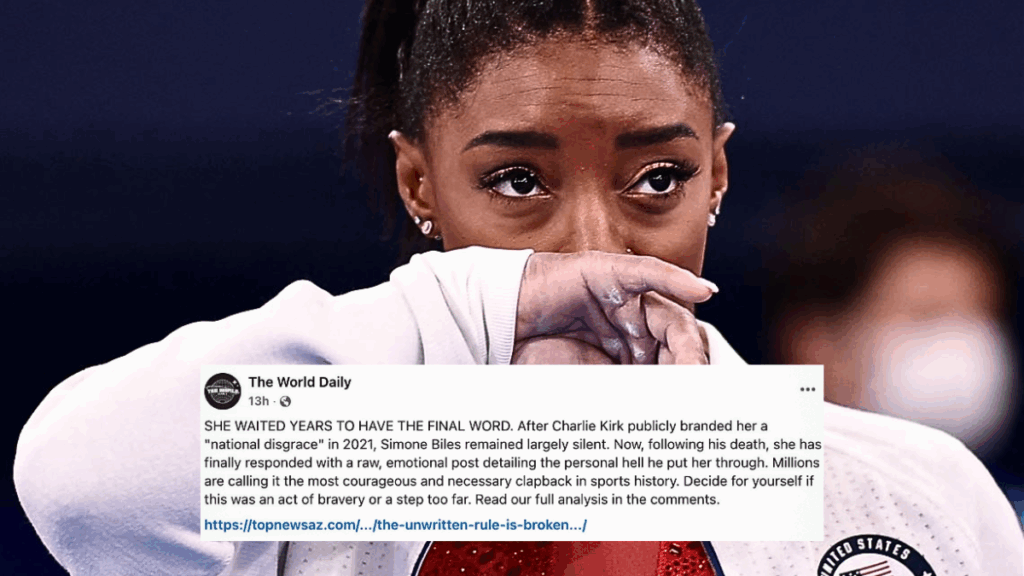
AI isn’t just making goofy cat pics anymore—it’s pumping out fake stories that look real enough to fool your grandma, your boss, and half your Facebook feed.
From bogus celebrity blogs to fake political scandals, this tech is turning lies into clickbait gold.
How AI Supercharges Disinformation
AI doesn’t sleep, doesn’t get drunk, and sure as hell doesn’t fact-check. It can crank out hundreds of fake news articles faster than CNN can say “anonymous source.”
That means one reckless rumor can spread like wildfire across Facebook, TikTok, and X before anyone realizes it’s total BS.
The scariest part? These posts don’t look like the sketchy chain emails your uncle used to forward. They look polished—like legit news sites.
Toss in some AI-generated screenshots or fake “blogs,” and suddenly Simone Biles is writing about Charlie Kirk when she never typed a word.
For trolls and grifters, this is a dream. They don’t need talent, just a laptop and Wi-Fi. And the rest of us get stuck trying to figure out what’s real and what’s AI slop.
What the FBI is Doing About It
The FBI’s been warning people for years about “deepfakes” and AI scams. They keep dropping bulletins telling everyone to watch out for fake celebrity endorsements, fake porn, and those wild political ads that just feel off.
If something looks too wild to be true, it probably is. Trust your gut.
Let’s be real, the feds love using stuff like this as an excuse to clamp down on speech they don’t like. If you’re MAGA, you already know how that playbook goes.
They’ll call it “safety,” but it’s usually just about keeping control of the narrative. That’s just how it is.
Notorious Hoaxes: Miles Mathis, Larry Nassar, and Beyond
AI hoaxes aren’t random. They love drama and go straight for names that already get people talking.
Take Miles Mathis, for example. This conspiracy theorist has been accused of faking his own essays with AI-style nonsense before AI was even trendy.
Some folks argue he’s trolling. Others think he’s just off his rocker.
And then there’s Larry Nassar, the infamous gymnastics doctor. His name pops up in fake stories all the time because, let’s be honest, it guarantees attention.
AI tools recognize that. Toss a notorious name into the mix, and suddenly you’ve got garbage headlines that people can’t help but share.
Pick a famous name. Add a dash of outrage. Facebook’s algorithm takes it from there.
It’s basically the same scam recipe behind fake celebrity deaths, OnlyFans leaks, or those wild fake Trump arrest stories. Wild how people just keep falling for it, right?
Frequently Asked Questions
Yes — Simone Biles is a millionaire. Multiple sources estimate her net worth to be somewhere around US$17-20 million as of recent years.
No — there is no evidence that Simone Biles wrote a blog post about Charlie Kirk after his death, as claimed in some viral social media posts. That story has been debunked. The claim appears to be part of a misinformation/AI-generated story that spread on Facebook and other platforms.
In 2021, during the Tokyo Olympics, Simone Biles withdrew from several events citing mental health concerns (including issues sometimes referred to as “the twisties”).
In response, Charlie Kirk publicly criticized her harshly. Some of the things he said:
He called her a “selfish toxic.”, He also said she was “a shame to the country.”
He claimed in some statements that “we are raising a generation of weak people like Simone Biles.”
He criticized her decision to withdraw as, from his viewpoint, not showing up when it counted and letting down the country.