




Italy taxes adult content creators — including OnlyFans and Fansly earners — an extra 25% income surcharge on top of standard rates under a law called the “tassa etica” (ethics tax). Today, June 30, 2026, is Italy’s annual income tax settlement deadline. Thousands of Italian adult creators are paying this bill alongside their regular taxes for the first time, after enforcement tightened significantly this year.
The Italian Revenue Agency (Agenzia delle Entrate) logged at least three high-profile undeclared OnlyFans income cases in June 2026 alone, including a Venice-area creator who earned over €270,000 on the platform while collecting unemployment benefits. Additionally, a Tuscany-based creator with reported earnings above €400,000 is facing back-payment demands.
The creator economy has evolved rapidly, with celebrities joining OnlyFans reshaping the creator economy alongside independent adult creators.
Key Takeaways
- Italy’s “tassa etica” adds a 25% surcharge to income tax on earnings from producing, distributing, or selling pornographic material — covering OnlyFans, Fansly, and Patreon
- The law dates to 2006 (Article 57, Law 248/2006) but is actively enforced against individual creators for the first time at scale in 2026
- A May 2026 Agenzia delle Entrate ruling confirmed the surcharge applies to creators using Italy’s flat-rate tax scheme, eliminating the most common exemption
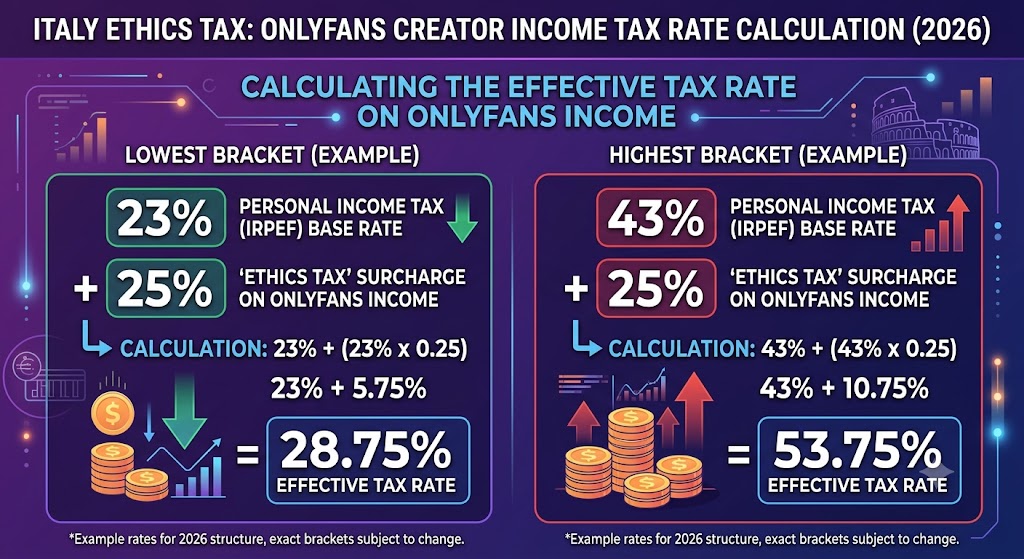
- At Italy’s highest income tax bracket of 43%, adult content creators now face an effective 53.75% rate on that income — before VAT
- The “Stop Tassa Etica” campaign by Radicali.it launched a parliamentary petition this week to repeal the law
What Happened — Italy’s Ethics Tax Hits OnlyFans Creators on the June 30 Deadline
Italy’s ethics tax is not a flat tax. It’s a multiplier applied to whatever income tax bracket a creator already occupies. A creator in Italy’s lowest 23% bracket pays 23% plus 25% of that 23% — an effective rate of 28.75% on adult content income. But, at the 43% top bracket, the math reaches 53.75%.
The 2006 law was designed with production companies in mind. For two decades, enforcement focused on incorporated adult entertainment businesses. The creator economy changed that calculation.
The pivotal shift came in May 2026, when the Revenue Agency confirmed the surcharge applies to creators using the regime forfettario — Italy’s simplified flat-rate scheme for small businesses earning under €85,000 annually. That door is now closed (Agenzia delle Entrate ruling, May 2026).
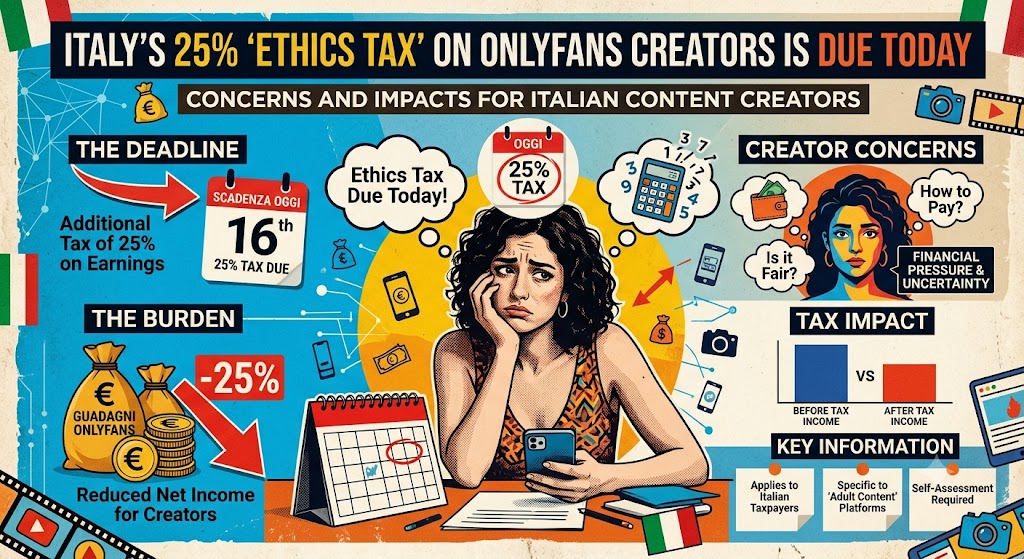
Italy’s ethics tax now applies to every Italian adult content creator regardless of business structure. The payment deadline is on June 30.
Is Italy’s Ethics Tax Unique in Europe — Or a Template?
| Country | Policy | Rate | Status |
| Italy | Ethics Tax income surcharge | +25% on income tax | Active — 2006 law, enforced 2026 |
| Florida (USA) | Proposed “sin tax” | 50% of gross revenue | Proposed, not enacted as of June 2026 |
| Turkey | Platform raids + seizures | Variable | Active — $7M seized in 2025 raid |
How Are Italian Creators Responding?
Several Italian creators posted itemized breakdowns of their actual 2025 tax bills on social media in June. Meanwhile, the structured pushback arrived through Radicali.it, Italy’s civil liberties party, which formally launched the “Stop Tassa Etica” signature drive this week.
No Italian political party has formally committed to repealing the law. No parliamentary vote is scheduled.

Background: A 2006 Law in the Creator Economy Era
The tassa etica originated in Italy’s 2006 budget law under Prime Minister Romano Prodi. The stated rationale: pornographic content production generates social costs borne by the public. Those costs should be partially offset by taxing the industry responsible.
Two things have changed since 2006. First, the industry it was designed to tax has largely been replaced by individual creators working from home. Second, platforms like OnlyFans paid out $6.3 billion to creators globally in 2025 (OnlyFans Transparency Report, March 2026). This has made adult content creation accessible at a scale the 2006 legislature never anticipated.
The ethics tax was designed to tax Brazzers. It’s now billing a freelancer in Venice with 800 subscribers.
ViceSnob’s Take
What’s actually interesting about Italy’s enforcement wave isn’t the tax itself — it’s the timing. For twenty years, there was selective enforcement against production companies. Then suddenly, a pivot to individual creators coincides with exactly the moment Italian creators have become visible enough to track via revenue data from platforms that didn’t exist in 2006.
Whether the Radicali.it campaign gets traction will tell us something about how seriously European countries are taking creator rights as a policy category. If the Italian model survives judicial and parliamentary scrutiny, then expect other EU countries to look at it as a template for adult content taxation without outright bans.
Platforms like OnlyFans have attracted not only independent creators but also celebrities who have joined OnlyFans. In turn, this has further expanded the creator economy.
FAQs
Italy’s “tassa etica” is a 25% surcharge added to income tax bills for earnings from producing, distributing, or selling pornographic material. Introduced in 2006 and now applied to individual OnlyFans and Fansly creators, it raises an Italian creator’s effective income tax rate by 25% — reaching 53.75% for top earners.
Yes. Italian adult content creators pay standard income tax (23%–43%) plus the 25% ethics tax surcharge and 22% VAT if registered as a business. A May 2026 Revenue Agency ruling confirmed this applies even to creators on the simplified flat-rate scheme.
No repeal vote has been scheduled as of June 30, 2026. The civil liberties party Radicali.it launched a formal petition drive this week. No major Italian party has publicly supported repeal.






Leave a comment