

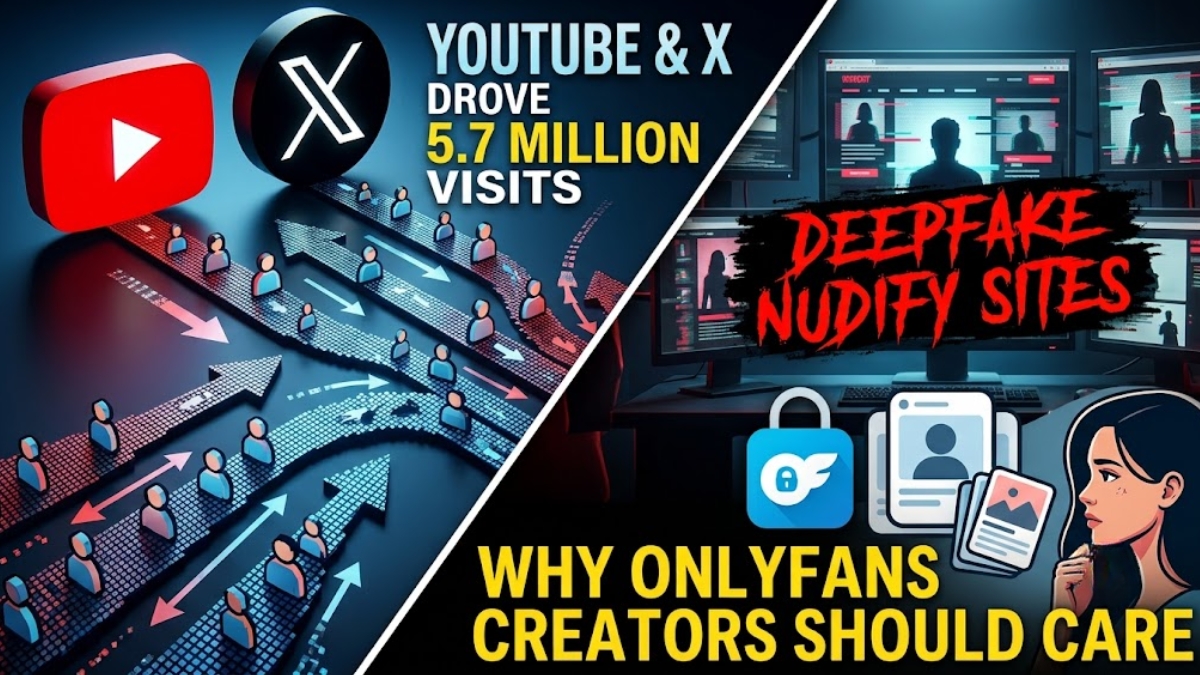
YouTube and X (formerly Twitter) generated over 5.7 million referral visits to nonconsensual deepfake “nudify” websites between December 2025 and March 2026, according to a study published July 16, 2026 by the Institute for Strategic Dialogue (ISD). YouTube alone accounted for 1.82 million of those visits — roughly 30% of the total — while X contributed over 1.3 million referrals.
Disclosure: this article has one affiliate link, to NordVPN. If you buy through it, we may earn a commission at no extra cost to you.
Key Takeaways
- 5.7 million visits to nudify sites originated from social media referrals between December 2025 and March 2026, with YouTube (1.82M, 30%) and X (1.3M+) as the primary traffic sources (Source: Institute for Strategic Dialogue study, July 16, 2026)
- $36 million per year — the estimated annual revenue of leading nudify platforms, despite individual images costing as little as $1 each (Source: Wired investigation, cited in ISD report, 2026)
- 90 schools across 28 countries have documented cases of deepfake abuse involving students, illustrating how far the technology has spread beyond adult platforms (Source: Wired and Indicator reporting, cited in ISD report, 2026)
- The Take It Down Act (enacted 2025) requires platforms to remove nonconsensual deepfake content within 48 hours of notification, while Minnesota has implemented a statewide ban on nudification apps (Source: Multistate policy tracker, February 2026)
- 54 civil society organizations have jointly urged U.S. state attorneys general to pursue legal action against companies operating nudification services (Source: ISD report, July 2026)
What Did the ISD Study Actually Find About Social Media and Nudify Sites?
The Institute for Strategic Dialogue — a London-based think tank that tracks online harms — published its findings on July 16, 2026, documenting how mainstream social media platforms function as pipelines to nonconsensual deepfake generators.
We reviewed the full report and the key findings are straightforward: YouTube and X aren’t just passively hosting links to these tools. They’re actively making them discoverable.
On YouTube specifically, researchers found videos functioning as tutorials and product reviews for nudification apps. Many included direct download links and promotional discount codes. That’s not an accidental gap in moderation — it’s a systematic failure to enforce policies that YouTube already has on the books prohibiting links to sexually explicit services.
X’s contribution was similarly substantial: over 1.3 million referral visits during the same four-month window. Researchers identified coordinated networks of accounts on X that continued promoting nudify tools as recently as June 2026, suggesting that enforcement actions haven’t disrupted the distribution channels.
The cost barrier is effectively zero. Users can generate nonconsensual explicit images for as little as $1 per output. That pricing — combined with tutorial-style promotion on the world’s largest video platform — creates a recipe for mass adoption that no content moderation team can realistically contain after the fact.
ISD researcher Melanie Smith stated that the data suggests YouTube “is not simply a passive intermediary but, in some instances, actively enabling access” to these services (Source: DigiCon Asia, July 16, 2026).
How Does the $36 Million Nudify Industry Threaten OnlyFans Creators?
The financial stakes here go beyond the nudification platforms themselves. A separate Wired investigation estimated that leading nudify services collectively generate up to $36 million annually — built entirely on nonconsensual imagery.
For OnlyFans creators, this creates a direct economic threat. When anyone’s likeness can be synthetically reproduced for $1, the fundamental value proposition of paid content platforms erodes. OnlyFans‘ entire business model rests on the premise that authentic, consent-based content has monetary value. Deepfake nudification attacks that premise at the root.
The harm extends well beyond economics. According to the ISD report, targets frequently include current or former partners and family members. Motivations range from harassment and reputational damage to attempts to jeopardize employment. This isn’t hypothetical — it’s documented across 90 schools in 28 countries, where student-generated deepfakes have already caused real-world consequences.
In one Singapore case highlighted by the Straits Times (May 2026), a man allegedly used a woman’s photograph to generate an AI nude image resembling her. Singapore Sports School students were separately investigated for generating and circulating deepfake nude photos of female classmates (Source: CNA, 2026).
For OnlyFans creators who build their income on platforms like OnlyFans, Fansly, or cam sites, the math is blunt: every freely accessible deepfake devalues the authentic paid content they produce.
What Laws Currently Address Deepfake Nudification in the U.S.?
The legislative response is building momentum but still lags behind the technology’s spread.
Current U.S. Regulatory Landscape
The Take It Down Act is the most significant federal action to date. It places the removal burden on platforms rather than victims, establishing a 48-hour window from notification to takedown. But the ISD report argues this is “insufficient to address the scale of the issue” — because the content regenerates faster than platforms can remove it.
Minnesota’s statewide ban on nudification apps takes a different approach: targeting the supply side rather than playing whack-a-mole with individual images. The ISD report and a coalition of 54 civil society organizations are pushing for this model to expand to other states.
The EU AI Act, which took effect in stages through 2026, adds another layer by requiring that all AI-generated content carry clear labeling and provenance data. For adult content platforms operating in European markets, this creates compliance obligations that could reshape how synthetic content is flagged and filtered.
None of these measures address the fundamental challenge: generating a deepfake takes seconds, but removing it takes days, legal resources, and emotional labor from the victim.
What Should OnlyFans Creators Do to Protect Themselves?
The practical reality for creators is that no law will fully prevent deepfake abuse. Protection has to be proactive, not reactive.
OnlyFans itself maintains a three-part defense system that the Virginia Law Review recently termed a “triple-lock” structure: identity verification for all creators, proprietary content infrastructure, and active copyright enforcement. That framework creates legal standing for takedown requests that individual creators acting alone typically lack.
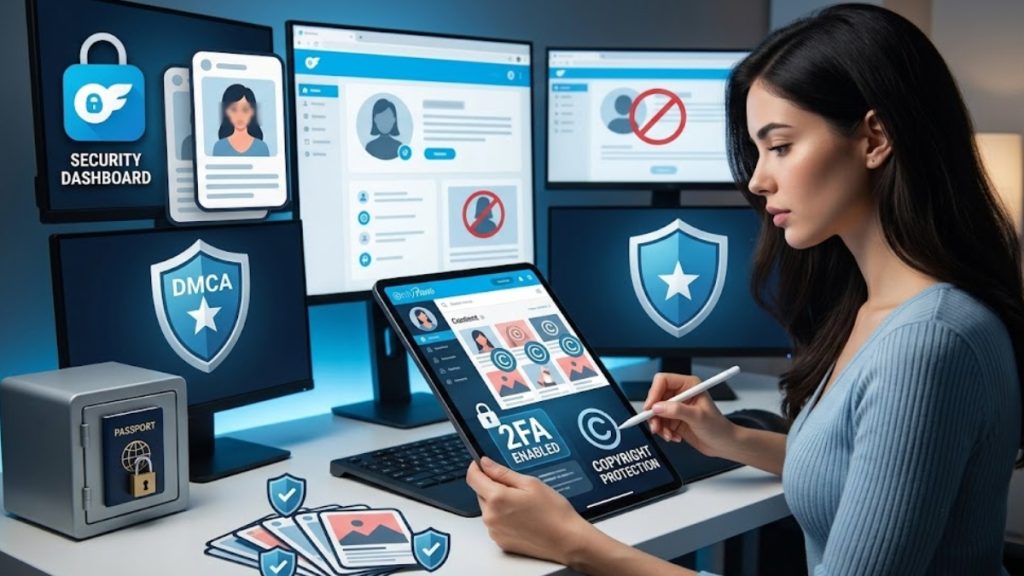
Creators operating outside of major platforms have fewer protections. But several steps can reduce exposure:
- Register copyrights proactively — U.S. copyright registration strengthens DMCA takedown claims and opens the door to statutory damages
- Document original content with timestamps — platform-verified upload dates establish provenance that deepfakes cannot replicate
- Use reverse image search monitoring — services like Google Images reverse search and dedicated tools can flag unauthorized use of your likeness
- Report to platforms using the Take It Down Act framework — the 48-hour removal clock starts at notification, so document and report immediately
The ISD study makes clear that the moderation gap exists at the referral stage — social platforms driving traffic to nudify tools — not just at the output stage. Until YouTube and X close those referral pipelines, the generation of nonconsensual content will continue to outpace removal.
A note on privacy
A VPN hides your IP address from the sites you visit and hides your browsing from whoever runs the network you’re on. It doesn’t hide your card payments from your bank, and it doesn’t hide your account from the platform. It also can’t stop anyone from copying or faking your photos. Don’t use it to get around age checks or country rules. That breaks the rules of most platforms.
If you want one for everyday privacy, NordVPN is the one we link to.
Affiliate linkWe may earn a commission if you buy, at no extra cost to you.
ViceSnob’s Take
We’ve covered a lot of creator economy stories, and this one sits differently. The ISD study isn’t about some abstract AI risk — it’s about 5.7 million people visiting websites designed to strip someone’s likeness without consent, guided there by tutorials on YouTube.
YouTube’s role here is particularly troubling. This is a platform owned by Alphabet, one of the most well-resourced tech companies on the planet, and it’s functioning as a discovery engine for tools that generate nonconsensual explicit imagery. The policy violations are clear. The enforcement is not.
For the OnlyFans creator community — the ecosystem we cover daily — this is an existential threat wrapped in a $1 price tag. The whole point of subscription-based adult content is that consent and authenticity have value. Nudify apps attack both simultaneously.
Minnesota’s approach — banning the apps themselves rather than chasing individual images — feels like the only strategy with real teeth. We’ll be watching whether other states follow, and whether OnlyFans’ own content protection infrastructure evolves to match the scale of the threat.
Frequently Asked Questions
YouTube drove approximately 1.82 million visits to nudify websites between December 2025 and March 2026, accounting for roughly 30% of the 5.7 million total social media referrals documented in the ISD study published July 16, 2026. Many of these visits came via tutorial-style videos that included direct links and promotional codes.
The legal landscape is evolving. The federal Take It Down Act (enacted 2025) requires platforms to remove nonconsensual deepfake content within 48 hours. Minnesota has implemented a statewide ban on nudification applications. A coalition of 54 civil society organizations is urging other state attorneys general to pursue legal action. However, there is no comprehensive federal ban on the creation of AI-generated nonconsensual explicit imagery as of July 2026.
A Wired investigation cited in the ISD report estimated that leading nudify platforms collectively generate up to $36 million in annual revenue, despite individual images costing as little as $1 each. The combination of low per-unit cost and massive volume — 5.7 million referral visits in just four months — makes this a highly profitable industry.




Leave a comment