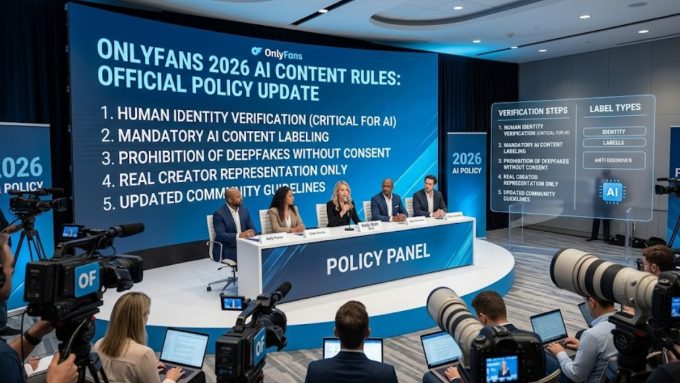



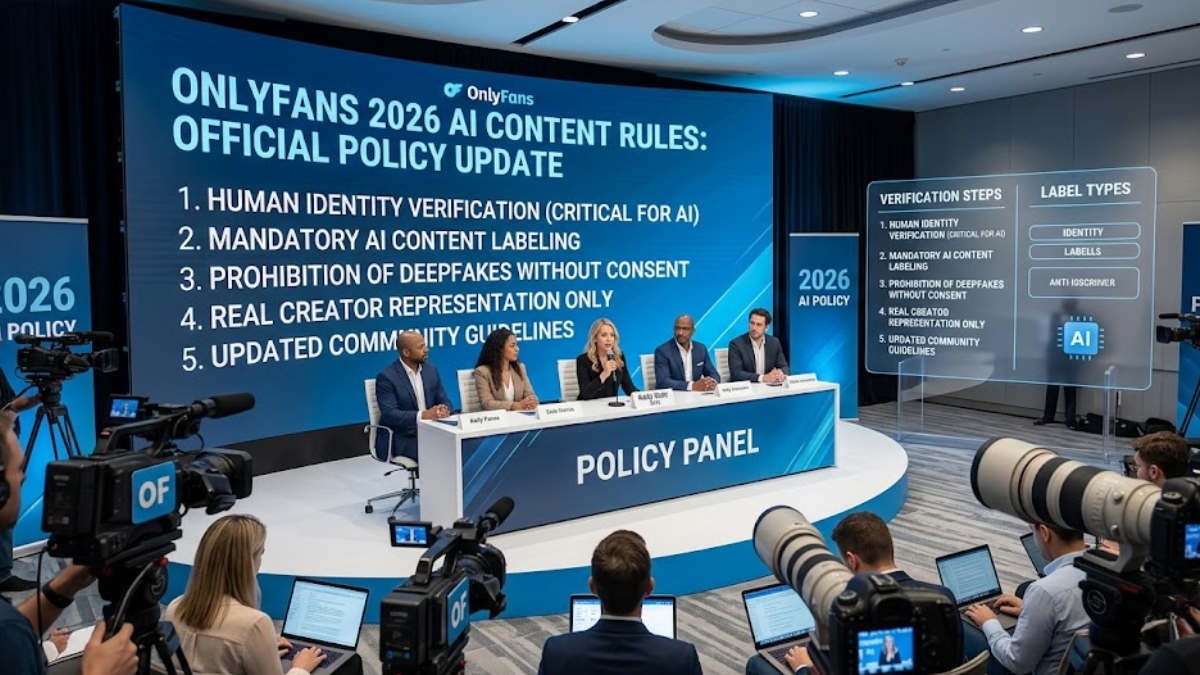
OnlyFans implemented four major AI content policy changes in 2026: mandatory AI content labeling with #AI or #AIGenerated tags, a zero-tolerance deepfake ban with permanent account termination, a creator resemblance requirement that blocks fully synthetic personas, and enhanced identity verification with annual liveness detection re-checks. These rules apply to all 4 million registered creator accounts. Additionally, the rules apply across the platform’s 377 million user base (Variety, May 2026).
Key Takeaways:
- 15–20% of new OnlyFans accounts now use some form of AI-generated content. This is up from an estimated 5–8% in 2024 (SexWorkCEO, citing OnlyFans internal data, 2026).
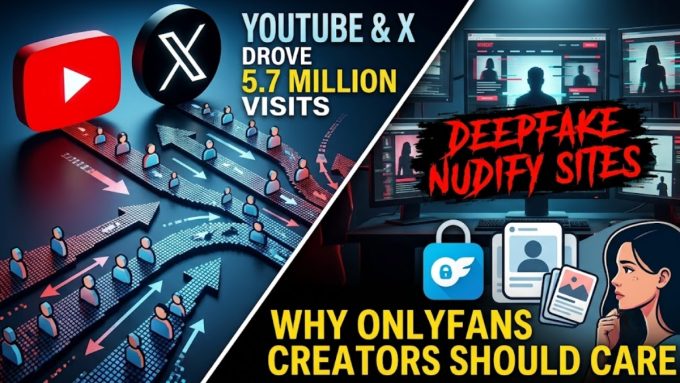
- Deepfake attacks across platforms surged over 1,000% in recent years. As a result, OnlyFans has drawn its hardest enforcement line ever — permanent bans with frozen payouts and potential law enforcement referral.
- The Take It Down Act, signed May 19, 2025, requires platforms to remove flagged non-consensual intimate images (including AI deepfakes) within 48 hours. Consequently, OnlyFans’ rules align with this federal mandate.
- AI business tools (chatbots, DM management, scheduling, analytics) remain completely unrestricted — the rules target only content subscribers see visually
- OnlyFans chose to regulate AI rather than ban it outright. This diverges from Fansly (which banned photorealistic AI content entirely in June 2025). Patreon also banned hyperrealistic AI content the same year.
Why Is OnlyFans Cracking Down on AI Content Now?
The timing connects directly to three converging pressures: federal legislation, platform competition, and a $3.15 billion valuation deal that demands regulatory credibility.
The Take It Down Act became enforceable on May 19, 2026, exactly one year after signing. Under this law, any covered platform — OnlyFans included — must implement a notice-and-takedown process for non-consensual intimate images within 48 hours. The FTC oversees enforcement. Separately, the DEFIANCE Act moving through Congress would give deepfake victims the right to sue creators, distributors, and hosting platforms directly.
OnlyFans’ timing also coincides with its May 2026 sale of a 16% stake to Architect Capital for $535 million, valuing the company at $3.15 billion (Variety, May 8, 2026). That deal — struck weeks after founder Leonid Radvinsky’s death at 43 from cancer — positions the platform for potential further acquisition. Moreover, clean AI governance makes the company more attractive to institutional investors who need regulatory compliance guarantees.
The third factor is market share defense. Fansly and Patreon have both banned photorealistic AI content entirely. OnlyFans chose a middle path — allowing AI under strict rules rather than prohibiting it — which could become a competitive advantage. This is especially true if creators prefer regulated flexibility over outright bans.
OnlyFans CEO Keily Blair framed the Architect Capital deal as an opportunity to “build additional services and features to support our creator community” (Variety, May 2026). Furthermore, AI governance is part of that infrastructure buildout.

What Exactly Do the Four New AI Rules Require?
Each rule targets a different dimension of AI use on the platform, and the penalties escalate based on severity.
Rule 1 — Mandatory AI Content Labeling: Any content that is AI-generated or uses significant AI enhancement must carry visible #AI or #AIGenerated tags in the caption. This includes AI-enhanced photos, AI-edited videos, and any content where AI materially altered what the subscriber sees. Standard editing tools (lighting correction, color grading, minor retouching) don’t require labeling unless the AI enhancement is significant.
Rule 2 — Zero-Tolerance Deepfake Ban: Any deepfake content, face-swap, or AI-generated explicit content depicting real people without consent triggers an immediate permanent ban. OnlyFans has stated severe violations may be referred to law enforcement. In addition, there is no warning tier for deepfake violations.
Rule 3 — Creator Resemblance Rule: All AI-generated content must resemble the verified human creator on the account. Fully synthetic personas and AI content depicting different people are prohibited. This distinguishes OnlyFans from platforms like Fanvue, which still permits fully synthetic AI creators.
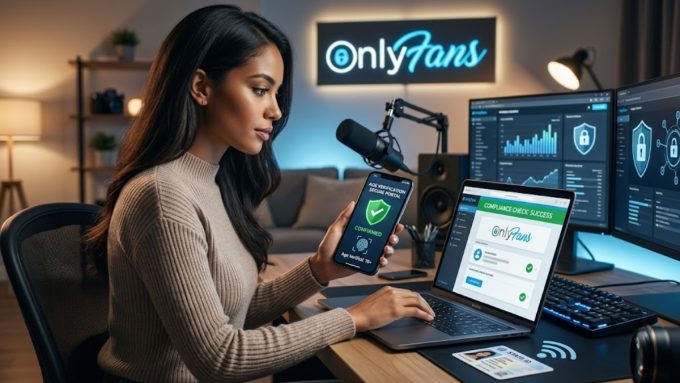
Rule 4 — Enhanced Identity Verification: The platform now requires liveness detection during verification — real-time proof of identity including blinking and head movement. Static selfies with ID are no longer sufficient. Creators must re-verify every 12 months.
For context on how OnlyFans monetization works under these new rules, our OnlyFans Overview and Creator Best Practices guide covers the full platform framework.
How Does This Affect the $7.2 Billion OnlyFans Economy?
The financial stakes are substantial. OnlyFans reported $7.22 billion in gross revenue for fiscal 2024, with net revenue of $1.41 billion and pre-tax profit of $684 million (Variety, May 2026). The platform has paid out more than $25 billion to creators since launching in 2016.
AI-generated content threatens this economic model in two ways. First, synthetic creator accounts dilute the market for human creators whose earnings already skew heavily toward the top — the top 1% of OnlyFans creators capture approximately 33% of total platform revenue, while the median creator earns $150–$180 per month (Everything PR, updated 2026; Aruna Talent, July 2026). Second, deepfakes create legal liability that could jeopardize the platform’s relationships with payment processors — the same vulnerability that nearly forced OnlyFans to ban explicit content entirely in 2021.
By implementing regulation rather than prohibition, OnlyFans is betting that managed AI integration will preserve creator trust without alienating the growing segment of creators who use AI legitimately for content enhancement. Whether that bet pays off will likely influence how the platform’s $3.15 billion valuation holds up as Architect Capital explores future growth.
For more on how creator earnings break down across the platform, see our Top 10 OnlyFans Creators Worth Your Money breakdown and our analysis of whether OnlyFans is actually worth subscribing to.
ViceSnob’s Take
We’ve been tracking OnlyFans policy shifts since the platform’s near-death experience in 2021, and these AI rules feel like the most consequential update since the explicit content ban reversal. The resemblance rule is the real story here — by requiring AI content to look like the verified creator, OnlyFans is drawing a line that says “this platform is for real people, enhanced or not.” That’s a philosophical stake in the ground that competitors haven’t matched.
The deeper question: does a platform earning $684 million in annual profit have the enforcement infrastructure to police AI content across 4 million creator accounts? The Take It Down Act gives the government a 48-hour removal mandate. However, identifying AI content at scale is an entirely different technical challenge than responding to individual takedown requests. We’ll be watching whether OnlyFans invests in detection technology or relies primarily on user reporting.
For creators, the practical takeaway is straightforward — label everything, verify annually, and don’t touch deepfakes. The financial consequences of non-compliance (frozen payouts, permanent bans) far outweigh the convenience of unlabeled AI enhancement.
Frequently Asked Questions
Yes. AI for DM management, chatbots, caption writing, video scripting, content scheduling, and analytics remains completely unrestricted. The new rules apply only to AI-generated or AI-enhanced visual content that subscribers see directly. Business-side AI tools do not require labeling.
A first offense for a missing label typically results in content removal and a warning. Repeated failures escalate to 7–30 day account suspensions where creators cannot post, message subscribers, or earn income. OnlyFans uses an escalating penalty model, so consistent non-compliance gets increasingly expensive.
OnlyFans chose regulated flexibility — AI is allowed under strict rules. Fansly banned photorealistic AI content entirely in June 2025. Patreon banned hyperrealistic AI content the same year. Fanvue still permits fully synthetic AI creators. OnlyFans’ middle-ground approach may attract creators who want to use AI enhancement without migrating to a more restrictive platform.










Leave a comment