


Yes — MintStars, a Harvard-incubated adult content platform, announced in June 2026 that its creators now collectively own 20% of the company. The equity is distributed based on each creator’s revenue, referrals, and time spent active on the platform. It’s the first adult subscription platform to offer co-ownership to its content creators, and it directly challenges OnlyFans’ models where creators generate all the revenue but own zero equity.
Key Takeaways:
- MintStars creators now own 20% of the company collectively, distributed by revenue, referrals, and activity (announced June 2026, Boston Globe, July 26, 2026)
- MintStars has approximately 10,000 creators and 32,000 fans as of July 2026, compared to OnlyFans’ estimated 3+ million creators
- OnlyFans takes a 20% commission on all creator earnings; MintStars shifts transaction fees to subscribers instead
- The equity came from cofounder Jessica Van Meir’s 23% stake — she donated it when leaving to pursue a PhD at Harvard Kennedy School
- An additional 3% was donated to SWOP Behind Bars, a nonprofit fighting for sex worker rights
- Architect Capital acquired approximately 16% of OnlyFans for over $500 million in May 2026, valuing the platform at roughly $3 billion+ (Bloomberg)
What Is MintStars and How Does Creator Equity Work?
MintStars is an adult content subscription platform founded in 2021 and incubated at Harvard Innovation Labs in Boston starting in 2023. The platform was selected as a semi-finalist for the 2023 Harvard President’s Innovation Challenge.
The company’s co-ownership model works like this: creators collectively hold 20% of MintStars’ equity, and individual shares are calculated based on three factors — revenue generated, new subscribers referred to the platform, and time spent actively creating content. If MintStars is ever sold or distributes profits, creators receive their proportional share of that 20%.
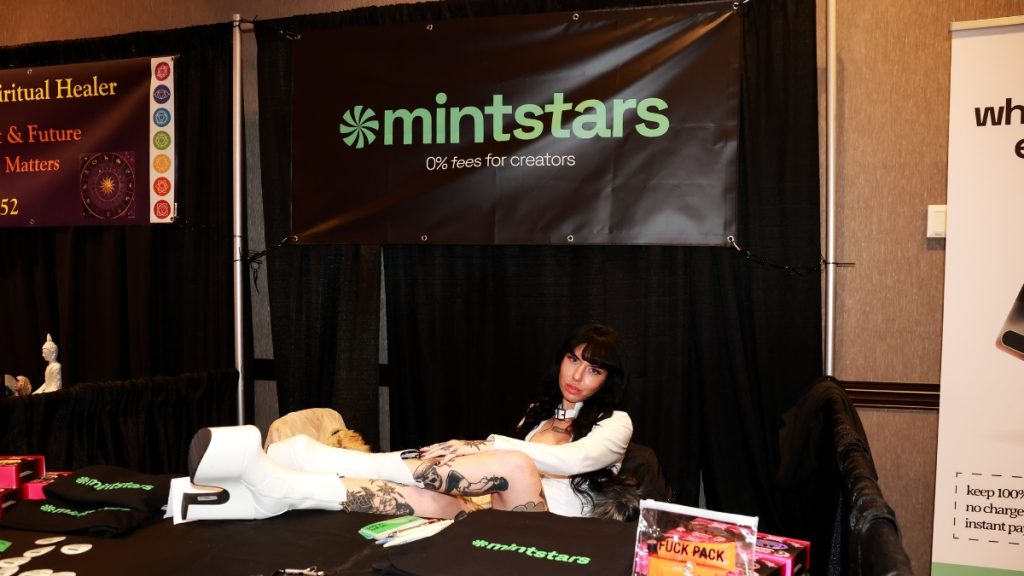
The equity originated from cofounder Jessica Van Meir’s personal 23% ownership stake. When Van Meir left MintStars to pursue a PhD in public policy at Harvard Kennedy School, she transferred 20% to the creator pool and donated the remaining 3% to SWOP Behind Bars, a nonprofit that advocates for incarcerated sex workers.
MintStars is now led by CEO Daniel Sargent (cofounder) and team lead Allie Eve Knox.
The platform currently hosts approximately 10,000 creators and 32,000 fans, according to Van Meir’s statements to the Boston Globe (July 26, 2026). Smaller creators earn hundreds of dollars per month, while top accounts generate $10,000+ monthly.
How Does MintStars Compare to OnlyFans for Creators?
The core difference is where the money goes. OnlyFans takes a flat 20% commission on every dollar a creator earns — subscriptions, tips, and pay-per-view sales. MintStars flips that model by placing transaction fees on subscribers rather than creators.

Here’s the side-by-side:
The scale gap is enormous and worth being honest about. OnlyFans has network effects that MintStars simply can’t match yet — a creator on OnlyFans benefits from a platform that 300+ million users already know by name. Discovery is still entirely creator-driven on both platforms (neither has a recommendation algorithm), but OnlyFans’ brand recognition does the heavy lifting for search traffic.
That said, the economics argument for MintStars is real. A creator earning $5,000/month on OnlyFans loses $1,000 to the platform’s commission. On MintStars, that $1,000 stays in the creator’s pocket — plus they’re building equity in the platform itself.
Why Are Investors Suddenly Interested in Adult Platforms?
The investment landscape for adult content platforms shifted dramatically in 2025–2026, and the numbers explain why.
Architect Capital acquired approximately 16% of OnlyFans for over $500 million in May 2026, just weeks after the death of majority owner Leonid Radvinsky, according to Bloomberg. That deal valued OnlyFans at roughly $3 billion+. Canadian private equity firm Ethical Capital Partners acquired MindGeek (Pornhub’s parent company) in 2023. Venture capitalists backed SLUSHY with over $10.2 million in seed funding in 2024.
Barnet Sherman, a corporate finance lecturer at Boston University, told the Globe that adult entertainment platforms attract investors because they’re “relatively low tech and low maintenance” compared to other industries — and the demand is consistent.
The investment thesis is straightforward: adult content is a $100+ billion global industry (IBISWorld, 2025), subscription models create predictable recurring revenue, and creator-driven platforms require minimal content production costs from the company itself. The platform just takes its cut.
What’s changing in 2026 is that investors are no longer hiding their involvement. The reputational barrier that kept mainstream capital away from adult platforms for decades is eroding as creator economy legitimacy grows and regulatory frameworks like the EU AI Act (effective August 2, 2026) and Ofcom’s UK age verification requirements bring the industry into a more structured legal landscape.
What Does MintStars Mean for OnlyFans Creators in 2026?
For the top OnlyFans creators earning six figures annually, MintStars’ co-ownership model is interesting but not yet compelling enough to justify a full platform switch. The audience gap is too wide — OnlyFans’ brand recognition drives organic discovery that no alternative can currently replicate.
For mid-tier and emerging creators, though, the calculus is different. If you’re earning $1,000–$5,000/month and haven’t yet built a locked-in audience, MintStars’ zero-commission model and equity participation could represent meaningfully higher take-home pay.
The smart play — and what we’re already seeing from savvy creators — is platform diversification. Run OnlyFans as your primary for audience reach, add MintStars (or Fansly, or SLUSHY) as a secondary for higher-margin revenue. Creator Goddess Raena, profiled in the Globe piece, earns at least $400/month on MintStars as a side gig alongside her engineering coordinator day job. That’s gas, groceries, and student loan payments — real money for a secondary platform.
The bigger question is whether the co-ownership model will scale. At 10,000 creators splitting 20% equity, individual shares are meaningful. At 100,000 creators, they’d be diluted significantly. MintStars hasn’t publicly addressed how equity distribution changes as the creator base grows, and that’s the detail sophisticated creators should be watching.
Sophie Rain’s $9.9 million year on OnlyFans proves the ceiling is highest on the dominant platform. But for creators building from scratch, the question of whether OnlyFans is worth it now has a legitimate counterargument for the first time.
ViceSnob’s Take
We’ve tracked OnlyFans alternatives for years, and most die on the vine — not because they’re bad products, but because they can’t crack the chicken-and-egg problem of needing creators to attract fans and fans to attract creators.
MintStars’ equity play is the first genuinely novel approach we’ve seen. It’s not just another “lower commission” pitch (though that matters). It’s aligning incentives in a way that no other adult platform has attempted — if the platform succeeds, creators directly benefit beyond their content earnings. That’s a fundamentally different value proposition.
The Harvard pedigree matters less than people think (a platform doesn’t gain subscribers because it was incubated at an Ivy League lab), but the investor backing from P2 Ventures and Escape Velocity suggests the company has enough runway to test whether the model works at scale.
Our honest assessment: MintStars won’t replace OnlyFans. Not in 2026, probably not ever. But it doesn’t need to. If it captures even 2–5% of the creator market by offering a genuinely better deal, that’s a viable business — and it pushes OnlyFans to improve its own creator economics. Competition is good for creators. Period.
Frequently Asked Questions
For new creators without an established audience, MintStars offers better economics — no 20% platform commission plus equity participation. However, OnlyFans has over 300 million registered users compared to MintStars’ 32,000 fans, meaning discoverability is significantly higher on OnlyFans. The best strategy for new creators in 2026 is to establish presence on OnlyFans for audience reach while running MintStars as a secondary platform for higher-margin revenue. Creators earning under $2,000/month benefit most from MintStars’ fee structure, where the $400/month saved in commissions represents a meaningful income boost.
MintStars’ 20% collective creator equity is distributed proportionally based on three metrics: revenue generated on the platform, new subscriber referrals, and time spent actively creating content. Payouts occur if the company distributes profits or is sold/acquired. As of July 2026, MintStars has not publicly disclosed specific equity values per creator or detailed how distribution calculations work as the creator base scales beyond its current 10,000 creators.
The leading OnlyFans alternatives in 2026 include Fansly (popular among creators diversifying from OnlyFans), SLUSHY (venture-backed with $10.2M in seed funding since 2024), MintStars (creator equity model), Exclu (0% commission on direct sales), and Fanvue (AI-friendly creator platform). The adult creator platform market has attracted over $500 million in institutional investment in 2025–2026 alone, according to deals tracked by Bloomberg and PitchBook, signaling that competition for OnlyFans’ market position is intensifying.






Leave a comment